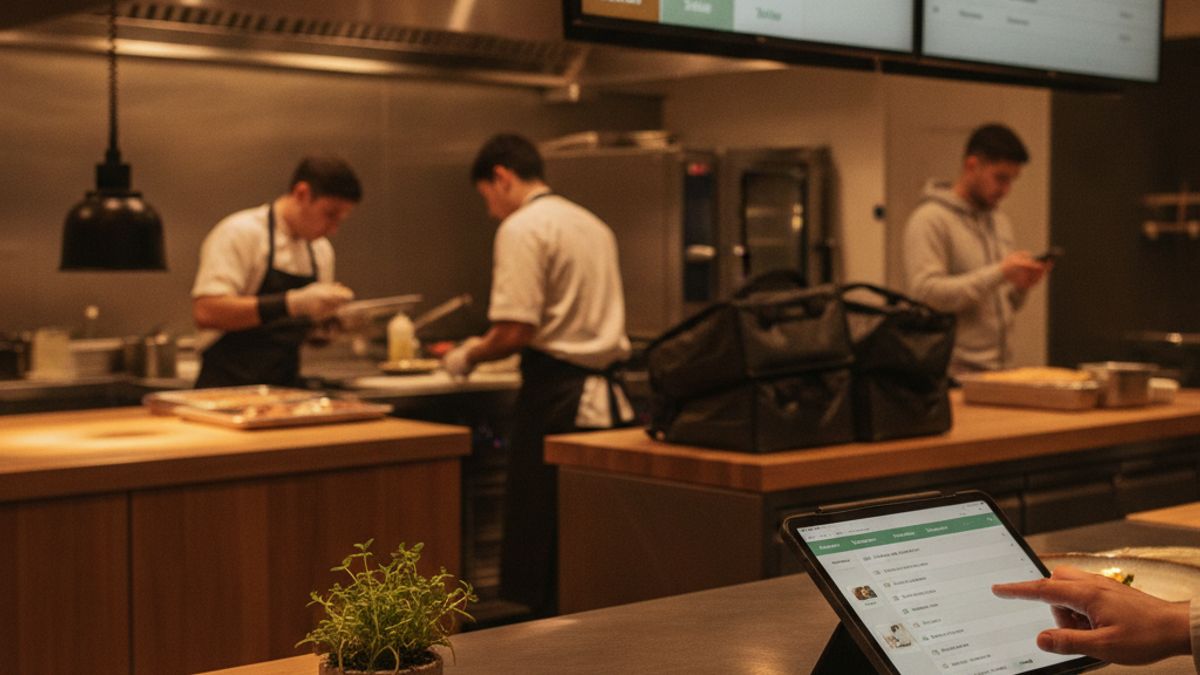
Managing delivery driver chaos: how to separate dine-in hospitality from courier pickups using digital tools
It is Friday night in your restaurant. Your dining room is fully booked, the ambient music is playing, and your guests are enjoying a carefully crafted hospitality experience. Suddenly, the front door swings open. Three couriers wearing bulky thermal jackets and motorcycle helmets push their way past waiting guests. They crowd the host stand, shoving smartphones into your staff's faces, demanding orders that are not yet ready. This is the daily reality of managing delivery driver chaos in the modern restaurant industry.
For independent operators across Europe, the explosion of food delivery has brought new revenue streams, but it has also introduced severe operational friction. Hospitality is about creating a welcoming, relaxed environment. Delivery logistics is about speed, efficiency, and turnaround times. When these two opposing forces collide at your front door, your dine-in experience suffers, your staff becomes overwhelmed, and your food quality drops.
It does not have to be this way. By implementing the right digital tools and restructuring your operational flow, you can successfully separate your dine-in hospitality from your courier pickups. In this comprehensive guide, we will explore practical strategies for managing delivery driver chaos, keeping your dining room peaceful, and ensuring your delivery dispatch runs like a well-oiled machine.
Table of contents
- The true cost of delivery driver chaos in your restaurant
- Why traditional restaurant layouts fail modern omnichannel operations
- Digital tools for separating dine-in hospitality from courier pickups
- Synchronizing kitchen production with driver arrival times
- How to design a dedicated courier pickup zone
- Training your staff to handle delivery dispatch professionally
- Taking control of your logistics with direct delivery
- How an all-in-one platform eliminates the friction
- Conclusion: reclaim your dining room
The true cost of delivery driver chaos in your restaurant
Many restaurant owners view a crowded lobby of delivery drivers as a sign of business success. However, beneath the surface of this high volume lies a significant hidden cost. When you fail at managing delivery driver chaos, the financial and reputational damage spreads across your entire operation.
First, consider the impact on your dine-in guests. People pay a premium to eat inside your restaurant for the atmosphere and service. If their romantic dinner or business meeting is constantly interrupted by shouting couriers and the rustling of insulated bags, they are unlikely to return. A single negative online review mentioning a chaotic atmosphere can cost you dozens of future reservations.
Second, driver chaos creates massive stress for your front-of-house team. Your hosts and servers are trained in hospitality, not logistics dispatch. When they are forced to act as traffic controllers for impatient couriers, they cannot properly attend to your seated guests. This leads to burnout, high staff turnover, and increased hiring costs.
Finally, there is the issue of order accuracy and food quality. In a chaotic pickup environment, bags get swapped, receipts get lost, and drivers end up taking the wrong orders. This results in costly refunds and angry customers at home. To truly master omnichannel restaurant operations: connecting dine-in, takeout, and delivery, you must recognize that logistics and hospitality require entirely different management approaches.
Why traditional restaurant layouts fail modern omnichannel operations
To understand why managing delivery driver chaos is so difficult, we have to look at how restaurants were historically designed. Traditional restaurant architecture follows a linear, single-purpose flow. Guests enter through the front door, wait at the host stand, move to a table, and eventually leave through the same door.
Modern food delivery breaks this traditional flow completely. It introduces a high-speed, parallel process that intersects with your dine-in operations at the worst possible bottleneck. The front door and the host stand become a collision zone. When third-party aggregators send drivers to your venue before the food is ready, your lobby is instantly transformed into an unmanaged waiting room.
Furthermore, legacy point-of-sale systems were never built to handle multiple ordering channels simultaneously. This has led to the dreaded tablet hell. Your host stand is likely cluttered with different tablets for various delivery apps, constantly ringing and requiring manual order entry into your main POS. The cashier is forced to look down at screens instead of up at the guests.
If you are tired of this fragmented setup, it might be time to look for a how Tayim compares to Glovo, Bolt Food and Wolt. By consolidating your technology, you can begin to rethink your physical space. You cannot easily change your building architecture, but you can change how digital information flows through your restaurant, which in turn dictates how people move through your space.
Digital tools for separating dine-in hospitality from courier pickups
The key to managing delivery driver chaos is replacing manual communication with digital automation. When a driver has to ask a human being if an order is ready, you have already lost the battle. Digital tools allow you to communicate with couriers silently and efficiently.
The most foundational tool is a centralized order management system. Instead of having staff manually punch in delivery orders, every order from every channel should flow directly into a single system. This eliminates the need for staff to interact with delivery tablets at the host stand. You can explore Tayim homepage - all-in-one restaurant management to see how a unified system instantly clears the physical clutter from your front-of-house.
Another critical digital tool is the customer-facing display screen, repurposed for couriers. By installing a digital screen in your designated pickup area, you can display the status of every delivery order in real time. Drivers walk in, look at the screen, and immediately know if their order is being prepared or if it is ready for pickup.
This simple digital intervention completely eliminates the need for couriers to interrupt your staff. It sets clear expectations and drastically reduces anxiety for both the drivers and your front-of-house team. When you review our complete feature set for restaurants, you will see how integrated digital displays transform the physical flow of your venue.
Synchronizing kitchen production with driver arrival times
One of the primary causes of delivery driver chaos is the mismatch between food preparation times and courier arrival times. If the driver arrives ten minutes early, they crowd your lobby. If they arrive ten minutes late, the food sits dying on the counter. Solving this timing issue is entirely dependent on your kitchen technology.
A modern Kitchen Display System is the brain of your production line. Unlike paper tickets, a smart KDS can dynamically pace orders based on your current kitchen capacity. It separates dine-in tickets from delivery tickets, routing them to the appropriate prep stations without confusing the chefs.
More importantly, an integrated system delays pinging the delivery driver until the food is actually reaching the final stages of preparation. By synchronizing KDS and delivery dispatch: how to guarantee hot food arrives on time, you ensure that the courier walks through the door exactly when the bag is being sealed.
This synchronization requires your POS, your KDS, and your delivery dispatch software to speak the exact same language in real time. Legacy systems patched together with third-party integrations often suffer from lag, leading to inaccurate prep times. A native, all-in-one platform ensures that the timing algorithm is always accurate, keeping drivers out of your lobby until the precise moment they are needed.
How to design a dedicated courier pickup zone
Digital tools are most effective when paired with smart physical boundaries. To truly protect your dine-in hospitality, you must create a dedicated courier pickup zone. This physical separation is the most visible step in managing delivery driver chaos.
If your floor plan allows it, designate a separate entrance for couriers. A side door or a back alley entrance completely removes delivery logistics from the guest experience. If a separate entrance is not possible, create a clear, partitioned path from the front door to a specific pickup counter located far away from the host stand and the dining tables.
Your pickup zone should be clearly marked with bold, multilingual signage. Use floor decals to guide drivers exactly where they need to stand. Equip the area with sturdy shelving, clearly labeled alphabetically or by order number. Add thermal bags or heat lamps to maintain food temperature while orders await pickup.
Most importantly, position your digital order status screen directly above the pickup shelving. The goal is to create a self-service environment for couriers. They should be able to walk in, check the screen, grab the correct bag, and walk out without ever speaking to a member of your hospitality staff.
Training your staff to handle delivery dispatch professionally
Even with the best digital tools and physical layouts, managing delivery driver chaos requires well-trained staff. Your team needs to understand the new standard operating procedures and know how to enforce boundaries professionally. Drivers are under immense time pressure, and their urgency can easily bleed into your restaurant's atmosphere.
Train your front-of-house staff to redirect couriers firmly but politely. Provide them with specific scripts. For example, if a driver approaches the host stand, the host should say, "All delivery pickups are handled at the side counter. Please check the digital screen for your order status." Consistency is key to changing courier behavior.
It is also crucial to train your expeditors. The person bagging the food holds the ultimate responsibility for order accuracy. They must ensure that receipts are stapled securely to the outside of the bags, with order numbers clearly visible. A sealed, clearly labeled bag prevents drivers from rummaging through orders and causing confusion.
Remember that couriers are essential partners in your business. Treating them with respect while enforcing strict operational boundaries creates a mutually beneficial relationship. When drivers know your restaurant is organized, fast, and professional, they will accept your orders more readily and handle your food with greater care.
Taking control of your logistics with direct delivery
While third-party aggregators provide visibility, they strip you of control. You cannot dictate how their algorithms dispatch drivers, and you have limited recourse if a driver behaves poorly in your restaurant. The ultimate solution for managing delivery driver chaos is to take ownership of the channel.
By launching your own direct ordering platform, you regain control over the entire logistical process. You can set realistic delivery radiuses, manage your own prep time estimates, and choose how drivers are dispatched. You can even build your own fleet or partner with a white-label delivery service that integrates directly with your system.
Transitioning to direct orders also has a massive impact on your bottom line. Instead of losing up to thirty percent per order, you keep your margins intact. You can use our free commission savings calculator to see exactly how much money you are currently losing to aggregators, and how much you could save by managing the process internally.
Building your own channel requires a strategic approach to logistics. If you decide to employ your own drivers, you need the right digital tools to track them. We highly recommend reading our guide on managing direct delivery logistics: how to handle drivers without marketplace apps to understand how to build a profitable, commission-free delivery fleet.
How an all-in-one platform eliminates the friction
The root cause of delivery driver chaos in most independent restaurants is a fragmented technology stack. When your online ordering, your POS, and your kitchen displays are provided by different companies, data gets lost in translation. Prep times are miscalculated, tickets get dropped, and drivers arrive at the wrong time.
An all-in-one restaurant management platform eliminates this friction by unifying every aspect of your operation. From the moment a customer clicks order on your white-label website, the data flows seamlessly. The POS processes the payment, the KDS sequences the preparation, and the dispatch module alerts the driver at the optimal moment.
This level of automation allows your staff to focus entirely on the guests sitting in your dining room. They do not have to manage tablets, they do not have to estimate prep times, and they do not have to argue with couriers. The software handles the logistics, allowing your team to handle the hospitality.
At Tayim, we built our platform specifically to solve these complex operational challenges for independent operators across Europe. We offer transparent pricing - free, solo, multi plans that allow you to modernize your tech stack without breaking the bank. You get enterprise-grade tools without the enterprise price tag.
Conclusion: reclaim your dining room
Managing delivery driver chaos is not just about improving efficiency. It is about protecting the soul of your restaurant. Your dining room should be a sanctuary for your guests, a place where they can escape the rush of the outside world. When you allow logistics to override hospitality, you sacrifice the very thing that makes your restaurant special.
By implementing smart digital tools, reorganizing your physical space, and taking control of your delivery dispatch, you can have the best of both worlds. You can maintain a high-volume, highly profitable delivery business while preserving a calm, welcoming atmosphere for your dine-in guests.
The transition starts with upgrading your technology. Stop fighting with fragmented systems and start automating your workflows. If you are ready to eliminate the chaos and streamline your operations, contact us for a discovery call today. Our team of experts will help you analyze your current setup and build a customized digital strategy.
Do not let third-party apps dictate the atmosphere of your restaurant. Take back control of your operations, protect your profit margins, and deliver exceptional experiences to every customer, no matter how they choose to order. Take the first step today and sign up for a free account to see how an all-in-one platform can transform your business.
Tags
Why Tayim?
- Zero commission - we take no percentage of your orders, unlike Glovo or UberEats which charge 15-30%
- All-in-one platform - POS, KDS, online ordering, delivery management, and analytics in one system
- Transparent pricing - free plan available, Solo at EUR 39/month, Multi at EUR 119/month
- Fully white-label - your customers see only your brand, not ours
- Custom on demand - we adapt the platform for any language, country, or specific need
Ready to modernize your restaurant?
Discover how Tayim can simplify your operations and eliminate commissions.